Focus Isn't the First Step: Why Safety Comes Before Learning

The Homework Battle Most Parents Know Too Well
Your child sits down to complete their homework.
They know the topic.
They have studied it before.
You have seen them solve similar questions successfully.
Yet today, something feels different.
A simple mistake leads to frustration.
A correction feels like criticism.
The pencil is thrown aside.
Tears appear.
The homework remains unfinished.
As parents, these moments can be confusing.
You may wonder:
“Why is my child reacting like this?”
“Why can they do it one day and struggle the next?”
“Why are they refusing something they clearly know how to do?”
The answer often has very little to do with intelligence, effort, or ability.
What many children are experiencing in these moments is a mismatch between two important states of the brain:
- The Active Brain
- The Calm Brain
Both are essential.
Neither works well without the other.
And understanding this balance can completely change the way we support our children.
At Bridge My Brain, I often tell parents that learning is not just study time.
Learning is brain time.
When we understand what the brain needs before it can learn, many daily struggles start making much more sense.
The Two Brain States Every Child Needs
Think about your own life for a moment.
Have you ever walked into an important meeting feeling anxious?
Perhaps you had prepared thoroughly.
You knew the material.
Yet suddenly your mind went blank.
Or maybe you were trying to solve a problem while feeling overwhelmed and found yourself making mistakes you would never normally make.
Children experience exactly the same thing.
The difference is that they are still learning how to regulate these emotions and experiences.
To understand why this happens, it helps to think of learning through two important brain states:
The Active Brain
The Active Brain helps children:
- Focus attention
- Solve problems
- Learn new concepts
- Process information
- Build memory
- Complete challenges
- Think critically
This is the part of learning most people talk about.
When parents say:
“Concentrate.”
“Think harder.”
“Try again.”
they are usually asking the Active Brain to work harder.
But there is another part of the equation that often gets ignored.
The Calm Brain
The Calm Brain creates:
- Emotional safety
- Confidence
- Regulation
- Trust
- Resilience
- Stability
- A willingness to try
The Calm Brain creates the conditions that allow learning to happen.
Without it, the Active Brain struggles to perform at its best.
A child may know the answer.
A child may have studied.
A child may have the ability.
But if the Calm Brain is missing, learning becomes much harder.

Why Safety Comes Before Learning
One of the most important lessons neuroscience has taught us is this:
The brain learns best when it feels safe.
When children feel emotionally secure, their brain can devote energy toward:
- Attention
- Problem solving
- Memory formation
- Creativity
- Exploration
When children feel threatened, embarrassed, judged, or overwhelmed, the brain redirects energy toward protection.
Learning moves into the background.
Survival takes priority.
This does not mean children are facing real danger.
For the developing brain, situations such as these can feel threatening:
- Fear of getting an answer wrong
- Being compared to others
- Repeated criticism
- Fear of disappointing parents
- Time pressure
- Constant correction
- Being laughed at for mistakes
The brain interprets these experiences emotionally.
When this happens, learning becomes more difficult.
Not because the child cannot learn.
Because the brain is busy protecting itself.
What Happens When States Are Out of Balance?
All Active, No Calm = The Overload Script
Many modern children spend their days in a state of constant activity.
School.
Homework.
Tuition.
Activities.
Sports.
Projects.
Exams.
Assessments.
Expectations.
From the outside, it may look productive.
But if there is not enough emotional safety and recovery, children can become stuck in a cycle of overactivation.
You may notice:
- Increased frustration
- Short tempers
- Perfectionism
- Anxiety
- Avoidance of challenges
- Emotional outbursts
- Difficulty focusing
- Reduced confidence
The child appears unmotivated.
But often they are simply overwhelmed.
The Active Brain is working hard.
The Calm Brain has been left behind.
Imagine driving a car with the accelerator pressed constantly while never allowing the engine to cool.
Eventually, performance drops.
The same happens with the brain.
All Calm, No Active = The Comfort Script
Balance works both ways.
Sometimes parents hear messages about reducing stress and interpret them as avoiding challenge altogether.
But growth requires challenge.
Children also need opportunities to:
- Solve problems
- Experience productive struggle
- Take risks
- Build resilience
- Learn new skills
- Stretch beyond their comfort zone
If a child remains only in a state of comfort, they may become:
- Passive
- Easily discouraged
- Dependent on guidance
- Reluctant to try new things
- Unwilling to take initiative
The goal is not permanent comfort.
The goal is supported challenge.
Children need to feel safe enough to try difficult things.
That is where real learning happens.
The Magic Formula: Active + Calm
The most powerful learning state occurs when both systems work together.
Calm Brain + Active Brain = Joyful Learning
This is where we often see children:
- Asking questions
- Exploring ideas
- Taking healthy risks
- Recovering from mistakes
- Staying focused longer
- Building confidence naturally
They are challenged.
But not overwhelmed.
They are engaged.
But not pressured.
They are learning.
But also enjoying the process.
This is the sweet spot we want to create.
A Small Shift That Changes Everything
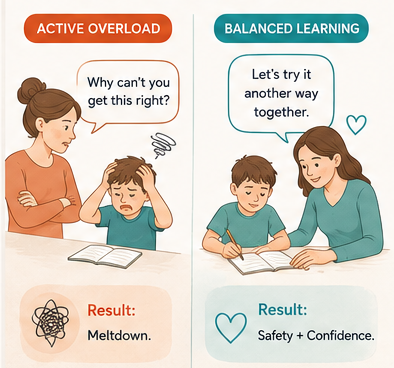
Consider these two common homework scenarios.
Scenario One
Parent:
“Why can’t you get this right?”
“What were you doing in class?”
“You know this already.”
The child hears:
“I’m failing.”
“I’m disappointing people.”
“I’m not good enough.”
Very quickly, learning stops.
Defensiveness begins.
The struggle grows.
Scenario Two
Parent:
“This looks tricky.”
“Let’s work through it together.”
“What part is confusing?”
“What have you understood so far?”
The child hears:
“I’m safe.”
“I can try.”
“Mistakes are allowed.”
“My effort matters.”
Nothing about the academic problem changed.
But the emotional environment changed completely.
And that changes how the brain responds.
Six Ways to Build the Active and Calm Brain Balance
1. Use Micro-Breaks
Attention is not designed to stay switched on endlessly.
Short breaks help reset the brain.
Try:
- Stretching
- Deep breathing
- Doodling
- Walking
- Drinking water
Even a few minutes can restore attention and reduce mental fatigue.
2. Change the Language
Language shapes how children experience learning.
Instead of:
“Why did you fail?”
Try:
“What did you learn?”
Instead of:
“That’s wrong.”
Try:
“Let’s look at another way.”
Small language shifts create psychological safety.
3. Create Space for Nature
Nature remains one of the most effective brain resets available.
Research consistently shows benefits for:
- Attention
- Mood
- Stress reduction
- Emotional regulation
A short walk outdoors can often do more for learning readiness than another worksheet.
4. Build Family Anchors
Children need predictable moments of connection.
Simple rituals matter:
- Family meals
- Bedtime conversations
- Music together
- Evening walks
- Storytelling
These moments strengthen emotional security and help regulate the nervous system.
5. Celebrate Progress
Results matter.
But progress matters too.
Children who receive recognition only for outcomes often become afraid of mistakes.
Children who receive recognition for effort, curiosity, persistence, and improvement become more willing to keep learning.
The goal is not perfection.
The goal is growth.
6. Bring Back Play
Play is one of the brain’s favourite learning tools.
Through play, children practise:
- Problem solving
- Creativity
- Language
- Memory
- Social skills
- Emotional regulation
Play keeps the Active Brain engaged while helping the Calm Brain feel secure.
That combination is powerful.
What the Science Really Tells Us
As we’ve explored throughout many of the topics here at Bridge My Brain, learning is not simply about information.
The brain learns best when several ingredients come together.
1. Emotion
Children remember experiences that feel meaningful.
2. Relevance
The brain pays attention when something matters.
3. Repetition
Repeated experiences strengthen neural pathways.
4. Neuroplasticity
The brain is constantly changing and adapting.
The more often children experience safe challenge, the stronger those learning pathways become.
This means the balance between Active and Calm is not fixed.
It can be trained.
It can be strengthened.
And it can become a lifelong advantage.
The Children We Are Really Trying to Raise
When parents think about success, they often picture:
- Good marks
- Strong performance
- Academic achievement
Those things have value.
But life asks for more than knowledge.
The children who thrive in the long run are often those who can:
- Stay curious under pressure
- Adapt to challenges
- Recover from setbacks
- Regulate emotions
- Keep learning through uncertainty
These abilities emerge when children learn to balance challenge with safety.
Focus with confidence.
Growth with resilience.
The goal is not simply to raise children who know more.
The goal is to raise children who can continue learning throughout their lives.
Final Thoughts
The best learning does not happen in stress.
And it does not happen in complete comfort either.
It happens when the brain feels safe enough to stay calm and challenged enough to stay active.
That balance is where confidence grows.
That balance is where resilience develops.
That balance is where meaningful learning begins.
At Bridge My Brain, I encourage parents to see learning not simply as study time, but as brain time. When we understand what the brain truly needs, we can replace daily battles with deeper connection, stronger confidence, and more joyful learning.
A Small Challenge for This Week
Add one Calm Brain moment to your child’s day.
It could be:
- A walk together
- A favourite song
- Ten minutes of storytelling
- A shared laugh
- A warm hug after a difficult day
Then observe what happens.
You may discover that a calmer brain creates a more capable learner.
Your Turn
What is one Calm Brain moment you would like to add to your child’s routine this week?
Sometimes the smallest changes create the biggest shifts.
Read on: 5 Learning Myths That Are Harming Your Child’s Brain