
How to Teach Kids About Money: Fun Financial Literacy Activities That Build Brain Skills

“If kids can master Minecraft and Roblox, why not money?”
Most parents wait until their children are teenagers to talk about money.
By then, children may already know how to spend—but not necessarily how to think about spending.
The truth is, financial literacy doesn’t begin with a bank account.
It begins the first time a child exchanges a coin for a chocolate, chooses between two toys, or decides whether to spend today or save for tomorrow.
Money is simply the medium.
The real lesson is learning how to think.
At Bridge My Brain, I believe teaching children about money isn’t about raising future bankers or entrepreneurs. It’s about nurturing decision-makers—children who can plan, evaluate, delay gratification, solve problems, and make thoughtful choices throughout life.
And the best part?
These lessons can begin much earlier than most parents imagine—and they can be wonderfully fun.
Why Financial Literacy Matters More Than Ever
We live in a world where children see money everywhere.
They watch online shopping.
They hear conversations about discounts.
They notice advertisements.
They ask for games, gadgets, and treats.
Yet very few children understand what money actually represents.
When children learn about money early, they don’t simply learn to count.
They begin understanding:
- value
- responsibility
- planning
- patience
- priorities
- consequences
These are life skills that extend far beyond finances.
A child who learns to save for a toy is also learning delayed gratification.
A child comparing prices is learning critical thinking.
A child planning purchases is strengthening executive function.
Money becomes one of the easiest ways to teach complex thinking skills through everyday life.
Start Small: Every Coin Is a Learning Opportunity
Financial education doesn’t require spreadsheets or investment apps.
It begins with simple everyday experiences.
As soon as children can recognise numbers, introduce them to coins and notes.
Let them:
- sort different denominations
- match coins to values
- count money aloud
- recognise the difference between needs and wants
Then take learning into the real world.
Allow your child to hand cash to the cashier.
Wait for the change together.
Count it before putting it away.
For adults, these are routine moments.
For a child, they are powerful learning experiences.
They begin understanding that money is exchanged for value—not magically created.
Without realising it, they are also strengthening mathematical thinking, attention, confidence, and communication.
Turn Everyday Shopping Into Brain Training
The grocery store may be one of the best classrooms your child will ever have.
Instead of rushing through the aisles, involve them.
Ask questions like:
“Which cereal gives us more for the same price?”
“Should we buy one large packet or two small ones?”
“Which option will last longer?”
“Do we really need this today?”
Suddenly, shopping becomes a thinking exercise rather than a spending exercise.
Children begin comparing, analysing, estimating, predicting, and reasoning.
These conversations build practical intelligence that textbooks rarely teach.

Learning Through Play Is Powerful
Children learn best when they don’t feel like they’re learning.
That’s why games are such effective teachers.
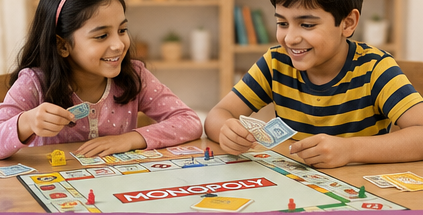
Classic board games like:
- Monopoly
- Payday
- The Game of Life
naturally introduce ideas such as:
- earning
- budgeting
- investing
- risk
- planning
- unexpected expenses
Don’t have board games?
Create your own family shop at home.
Use toys as products.
Create price tags.
Give everyone pretend money.
Let your child become both customer and shopkeeper.
They’ll practice arithmetic, communication, negotiation, and decision-making without opening a workbook.
Introduce Big Financial Ideas Naturally
Many parents assume concepts like interest, tax, or investment are too complicated.
Children often surprise us.
The key isn’t simplifying the concept.
It’s simplifying the experience.
Saving
Give your child three jars:
- Spend
- Save
- Share
Watching savings grow makes the concept tangible.
Interest
Offer a simple family challenge.
“If you save ₹20 this week, I’ll add ₹2 next week.”
Children immediately understand that money can grow over time.
Taxes
While sharing dessert, remove a tiny portion.
Smile and say,
“That’s today’s family tax!”
The laughter helps them remember the idea long before they study economics.
Supply and Demand
Bake ten cookies.
When everyone wants one, discuss why they disappear quickly.
Then imagine baking fifty.
Children begin understanding scarcity without reading a single economics chapter.
Learning becomes meaningful because it connects directly to real life.
The Hidden Brain Skills Money Builds
This is where financial literacy becomes brain development.
Every money conversation strengthens important cognitive abilities.
Executive Function
Planning purchases.
Making choices.
Managing goals.
Resisting impulsive decisions.
Working Memory
Remembering prices.
Calculating totals.
Following shopping lists.
Holding information while making decisions.
Numerical Reasoning
Understanding quantity.
Comparing value.
Estimating costs.
Recognising patterns.
Cognitive Flexibility
Changing plans when budgets change.
Finding alternatives.
Considering multiple options before deciding.
Cause and Effect Thinking
“If I spend everything today…”
“…I won’t have enough tomorrow.”
Children begin understanding consequences before experiencing major life mistakes.
Delayed Gratification
Perhaps the greatest life skill of all.
Waiting.
Planning.
Saving.
Choosing tomorrow’s bigger reward over today’s smaller temptation.
Research consistently shows that children who develop delayed gratification often find it easier to manage goals, emotions, and long-term success later in life.
Money simply becomes the practice ground.
Three Fun Money Brain Activities
1. Mini Shop Challenge
Create a grocery store at home using toys or household items.
Give your child pretend money.
Let them shop, sell, calculate, and make change.
Skills developed:
- planning
- counting
- communication
- decision-making
2. Deal Detective
Show two similar products.
Ask:
“Which gives us better value?”
Instead of giving the answer, let your child explain their thinking.
This builds analytical reasoning and confidence.
3. Save, Spend & Share Jars
Create three transparent jars.
Every time your child receives money, encourage them to divide it between:
- Save
- Spend
- Share
Watching the jars slowly fill teaches patience, generosity, and planning all at once.
Small Conversations Create Lifelong Habits
Financial education doesn’t require formal lessons.
It happens naturally when children are included in everyday family decisions.
Invite them into conversations.
Ask their opinions.
Let them make small mistakes.
Celebrate thoughtful choices.
Children don’t become financially responsible overnight.
They become financially confident one conversation at a time.

Final Thoughts
Money isn’t the real lesson.
Decision-making is.
Responsibility is.
Planning is.
Confidence is.
Money simply provides one of the most practical ways to build these skills.
At Bridge My Brain, I believe every everyday experience can become an opportunity to strengthen the brain. A trip to the supermarket, a board game after dinner, or saving for a favourite toy can all nurture thinking skills that last a lifetime.
So this week, choose just one money word—saving, spending, or sharing. Introduce it during a real-life moment, ask your child a few questions, and let curiosity lead the conversation.
You may discover that you’re not just teaching your child about money.
You’re helping them build a brain that can think, plan, choose wisely, and thrive in the real world.